Two Bridges, One Persistent Problem: Terrabella and Scabbing Flat
Written by Margaret Stevenson.
For more than a century, the river crossings at Terrabella and Ponto have tested the same proposition: that rural communities should be able to move stock, grain, wool and people safely across the waterways that shape their districts. At Terrabella, on the Little River, the issue was resolved in 2022 with a new dual-lane concrete bridge.
At Ponto, the historic Scabbing Flat Bridge over the Macquarie River remains caught between heritage conservation and the demands of a modern agricultural economy. Together, the two crossings tell one continuing story: communities have always needed reliable bridges, while governments have often been slow to provide them.
Before the bridges
In the nineteenth century, a flooded creek could sever a district as effectively as a closed railway line. For selectors and pastoralists around Wellington, Dubbo, Terrabella and Ponto, the Little and Macquarie rivers were both lifelines and barriers. Wool had to reach market, grain had to reach mills and sidings, and families needed dependable access to schools, stores and medical help.
The earliest crossings were often improvised. Local landholders formed committees, subscribed money and used neighbourhood labour, local timber and stone to create low-level structures that flood could damage or destroy. These were not grand public works; they were acts of collective survival. Yet they demonstrated that the routes carried enough traffic and produce to justify more formal investment.
The pattern appears again in Macquarie Shire Council’s records. After floods damaged roads and bridges in 1941, the council president thanked Mr Rupert Stevenson and others who had built a crossing over the Little River “without any help whatever from the Council” (Wellington Times, 1941, p. 4). When official resources lagged, local people filled the gap.
Terrabella: a dangerous crossing
By the late nineteenth century, Terrabella’s original crossing had become a source of dread. In July 1899, the Wellington Times reported that workmen were preparing to build a new bridge over the Little River. While the district was enjoying the benefits of rain, the correspondent warned that the old structure had “for a long time been in a very dangerous state” and that a serious accident had been narrowly avoided the previous week (Wellington Times, 1899, p. 3).
For a selector hauling grain or a teamster moving wool, a failing crossing threatened livelihoods as well as safety. Terrabella’s troubles continued after the 1899 works. In February 1907, fire destroyed part of the bridge after maintenance workers burning a log were caught by a change of wind. Farmers fought the blaze for around twelve hours before cutting away sections to prevent its spread (Wellington Times, 1907, p. 3). With the crossing damaged, teamsters struggled to ford the river; one wagon reportedly needed thirty-six horses to pull it through.
A replacement bridge was completed in January 1908, its cost shared by the state department and the Talbragar and Macquarie shires (Dubbo Dispatch and Wellington Independent, 1908, p. 2). It solved an immediate crisis, but Terrabella’s infrastructure story was not over.
Ponto: the “switchback” bridge
At Ponto, near Geurie, similar anxieties played out on a larger scale. The Scabbing Flat crossing became notorious because it failed in ways that seemed to local observers both predictable and avoidable.
In 1903, stock inspector Mr R. G. Dulhunty reported that the recently erected government bridge was “of a low-level description” and had collapsed after a fresh. Although he crossed on his bicycle, no vehicle traffic could pass because the centre had sunk. He predicted that a major Macquarie flood would sweep it away and argued that a high-level bridge would have been cheaper in the long run (Dubbo Liberal and Macquarie Advocate, 1903, p. 3).
The following year, a Wellington Times correspondent called the Ponto—or “Scabby”—bridge “the most unornamental, if not the most useless and most costly structure of its kind in the State.” Concrete piers had not been founded on bedrock; water had scoured away gravel; the piers had shifted; and the decking had become a series of “hills and hollows.” The writer estimated that construction and repairs had already cost £400 and warned that continued patching would eventually cost more than a proper bridge (Wellington Times, 1904, p. 3).
By 1907, frustration had become satire. The paper described a bridge that began “in a majestic and the orthodox manner” before sagging toward the water, with a central “lump like a dromedary.” Its railings had disappeared downstream, replaced by “pine sticks” meant to keep animals from falling into the river (Wellington Times, 1907, p. 6). The humour was sharp because the danger was real.
Agitation and replacement
Local advocacy eventually brought results. In October 1908, the Wellington Times noted that, “after a long agitation,” there was at last a prospect that the Scabbing Flat bridge would receive attention (Wellington Times, 1908). Two years later, it announced that the replacement high-level bridge was complete and traffic had begun crossing it.
The report contrasted the quiet opening with the earlier celebration of the old bridge, which had supposedly involved “flourish of trumpets, brass bands [and] good beer.” The new bridge opened with “no John Haynes, no ribbon, no champagne,” but what mattered was that traffic could cross (Wellington Times, 1910, p. 5).
That 1910 structure became the Scabbing Flat Bridge known today: a timber truss bridge built for an era of very different loads, vehicle widths and flood behaviour. Like Terrabella’s later timber bridge, it eventually became a bottleneck for modern rural transport.
Two paths after 1910
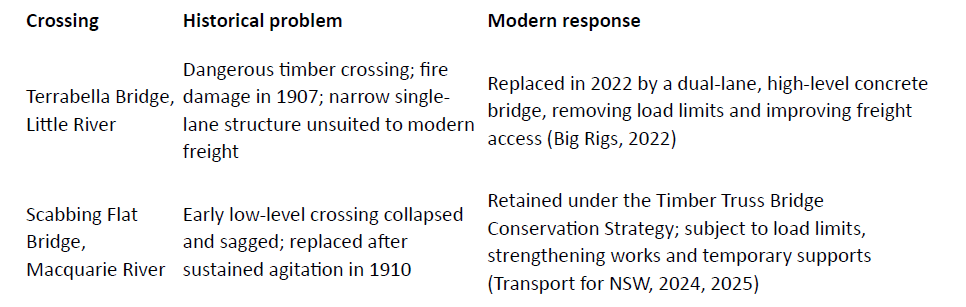
The crossings then followed different courses. Terrabella’s replacement timber bridge, built around 1921, remained a narrow, single-lane structure unsuited to contemporary freight. In 2022, after a $4.37 million project funded by the NSW and Australian governments and Dubbo Regional Council, it was replaced by a dual-lane, high-level concrete bridge (Big Rigs, 2022). The new crossing removed load limits and gave local producers a safer, more efficient route over the Little River.
Scabbing Flat followed another path. Its 1910 timber truss bridge came to be valued as part of a scarce collection of historic timber truss bridges in NSW. Under the Timber Truss Bridge Conservation Strategy, Transport for NSW identified a group of bridges for retention because of their heritage significance (Transport for NSW, 2024). Scabbing Flat was included on that list.
That decision preserved an important piece of engineering and social history. Timber truss bridges demonstrate the long-term application of local hardwood and engineering skill in regional road building (Transport for NSW, 2024). But heritage recognition also created a practical dilemma: Transport for NSW was required to retain and maintain the bridge rather than replace it (Transport for NSW, 2025).
The modern repair cycle
From late 2023, safety concerns imposed a 16-tonne load limit on Scabbing Flat Bridge. Transport for NSW replaced decayed timber, installed temporary supports, repaired piers and replaced cross girders and stringers. A temporary Bailey bridging support was also installed in the truss spans (Transport for NSW, 2025).
For local producers, the consequences were immediate. Heavy vehicles faced restrictions, repair closures and uncertainty during harvest. The bridge’s limitations affected the movement of grain, wool, livestock and machinery across a district dependent on efficient freight. The irony was unmistakable: a structure built after a decade of local agitation to replace a failing crossing had itself become the focus of another long campaign.
In 2025, Transport for NSW allowed eligible producers to apply for permits to operate heavier vehicles while strengthening work continued, with an aim of permitting vehicles up to 42.5 tonnes by mid-October 2025, subject to width restrictions (Transport for NSW, 2025). The underlying issue remained, however: the bridge was being kept operational through increasingly complex intervention.
Heritage and productivity
The contrast with Terrabella is not simply old timber versus new concrete. It is a contrast between two ways of resolving the same problem.
Heritage listing is not an abstract imposition. It recognises that Scabbing Flat Bridge is part of a finite collection documenting the development of NSW road engineering, and its timber trusses connect present-day travellers with the people who demanded and built earlier crossings.
But heritage cannot be separated from use. A bridge is part of a working road network, not a museum object standing apart from daily life. When a heritage structure can no longer carry the vehicles a district needs, communities are entitled to ask how conservation, safety and productivity can be balanced.
An unfinished story
In 2026, the NSW Government opened a statewide review of the Timber Truss Bridge Strategy. Transport for NSW acknowledged that communities including Scabbing Flat had told it the current strategy was “no longer meeting their economic and productive needs,” and invited feedback from councils, heritage groups, industry and road users (Trade Trucks, 2026).
For Ponto and Geurie, the review is another turn in a story that began long before the present bridge was built. In 1903, a local observer warned that repeated repairs to a low-level crossing would cost more than a proper high-level bridge. In 1904 and 1907, residents mocked a structure that sagged, shifted and endangered loaded teams. In 1908, they agitated; in 1910, they received a new bridge.
More than a century later, the language has changed, but the demand has not. Communities want a crossing that is safe, reliable and capable of carrying the freight on which their district depends. Terrabella’s concrete bridge shows what resolution can look like. Scabbing Flat shows how difficult it becomes when a working crossing is also a heritage asset.
The challenge is not to choose blindly between history and productivity. It is to determine whether Scabbing Flat Bridge can continue to serve its community without compromising safety or the economic life of the district it was built to connect. Until that balance is found, the voices of 1899, 1903, 1907 and 1910 still echo across the Macquarie: a river crossing is never merely a bridge. It is the difference between access and isolation.
Have your say
The sustained advocacy of the Scabbing Flat Bridge Action Group, local freight operators, farmers, the mayor and concerned community members—including parents whose children cross the bridge each school day—has helped bring about a significant shift in the state’s approach to heritage-listed timber bridges. The NSW Government has now opened a statewide review of the Timber Truss Bridge Strategy, acknowledging that some century-old structures are no longer meeting contemporary safety, economic and freight needs.
For the Ponto and Geurie communities, the review offers a genuine opportunity to reconsider the restrictions placed on Scabbing Flat Bridge and to secure a safe, modern crossing capable of serving the district’s future. More than a century after local residents first campaigned for a reliable bridge over the Macquarie, the call for a practical and lasting solution continues. Have your say at https://www.haveyoursay.nsw.gov.au/TTBS-review
References
Big Rigs. (2022, December 20). New Dubbo bridge allows for higher load limits. https://bigrigs.com.au/2022/12/20/new-dubbo-bridge-allows-for-higher-load-Dubbo Dispatch and Wellington Independent. (1908, January 29). The new bridge at Terrabella. Trove. https://trove.nla.gov.au/newspaper/article/227036222
Dubbo Liberal and Macquarie Advocate. (1903, August 15). Country trips. Trove. https://trove.nla.gov.au/newspaper/article/75970294
Trade Trucks. (2026, September 29). NSW seeks input on historic timber bridges. https://www.tradetrucks.com.au/nsw-seeks-input-on-historic-timber-bridges/
Transport for NSW. (2024, January 29). The Timber Truss Bridge Strategy. https://www.transport.nsw.gov.au/operations/roads-and-waterways/environment-and-heritage/heritage/timber-truss-bridges/timber-truss
Transport for NSW. (2025, March 28). Local producers get load limit boost on Scabbing Flat Bridge [Media release]. https://www.transport.nsw.gov.au/news-and-events/media-releases/local-producers-get-load-limit-boost-on-scabbing-flat-bridge
Wellington Times. (1899, July 31). Terrabella. Trove. https://trove.nla.gov.au/newspaper/article/138999946
Wellington Times. (1904, January 7). Through the district on horseback. Trove. https://trove.nla.gov.au/newspaper/article/137888968
Wellington Times. (1907, February 25). Terrabella bridge: The extent of the damage. Trove. https://trove.nla.gov.au/newspaper/article/141595137
Wellington Times. (1907, September 26). Geurie. Trove. https://trove.nla.gov.au/newspaper/article/141603319
Wellington Times. (1908, October 15). Local jottings. Scabbing Flat Bridge, Trove. https://trove.nla.gov.au/newspaper/article/141594493
Wellington Times. (1910, July 21). District news: Scabbing Flat Bridge. Trove. https://trove.nla.gov.au/newspaper/article/141502315
Wellington Times. (1941, February 10). Macquarie Shire Council. Trove. https://trove.nla.gov.au/newspaper/article/141622844
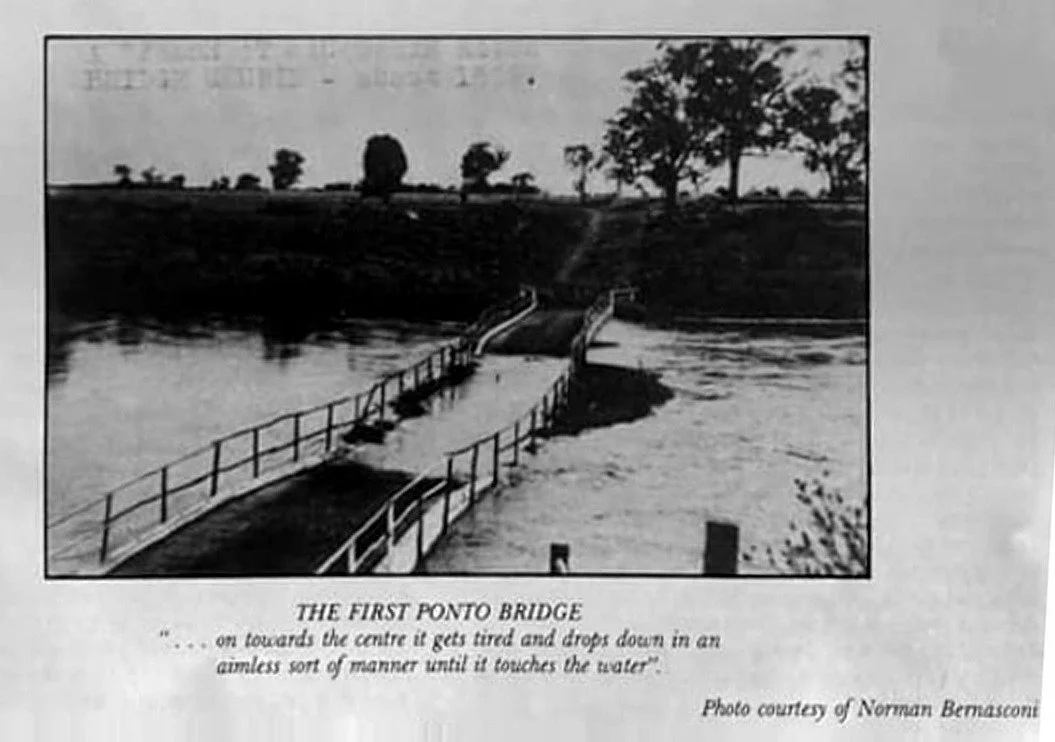
The first Ponto Bridge
Before there was a bridge, farmers crossed the Macquarie River at a ford. Heavy teams hauling produce could get across, but the steep northern bank had to be climbed carefully to avoid spilling a load. After heavy rain, rising water could stop crossings for long periods.
Calls for a bridge began around 1900. The timing seemed right: the local Member of Parliament, John Haynes, was also Minister for Works, and bridges came under his portfolio.
The Ponto-Suntop Farmers and Settlers Association asked for a bridge near the ford. Not everyone agreed on the site. P. F. Madden of “Meadowbank”, Terrabella, wrote to the Wellington Times arguing that “Peach Trees”, a short way downstream, was better. He said the banks there were more suitable, and that farmers could reach either the Murrumbidgerie (Wongarbon) or Geurie railway stations with their produce. In the end, the bridge was built where the Association had recommended.
The opening drew a large crowd of locals and dignitaries. They included Minister for Works John Haynes, J. Hurley (Member for Hartley), C. Oakes (Member for Paddington) and S. Law (Member for Balmain South). The parliamentarians arrived on the morning train from Sydney, had breakfast at Reynolds’ hotel, and were escorted to the bridge by Mr Littlejohns, President of the Progress Association.
Seeing how modest the bridge looked beside the lavish celebrations, Mr Haynes joked about “whether the trees and logs would float over or under it”. When that drew laughter, he added that if it washed away, the Government would build “a bigger and better bridge”. Amid more applause, Miss L. Reynolds named the structure “Ponto Bridge” and christened it with a bottle of wine. The celebrations then moved to Reynolds’ hotel for a banquet, speeches and entertainment.
Source: [ We are currently searching for the book title, author, page that the above words came from].